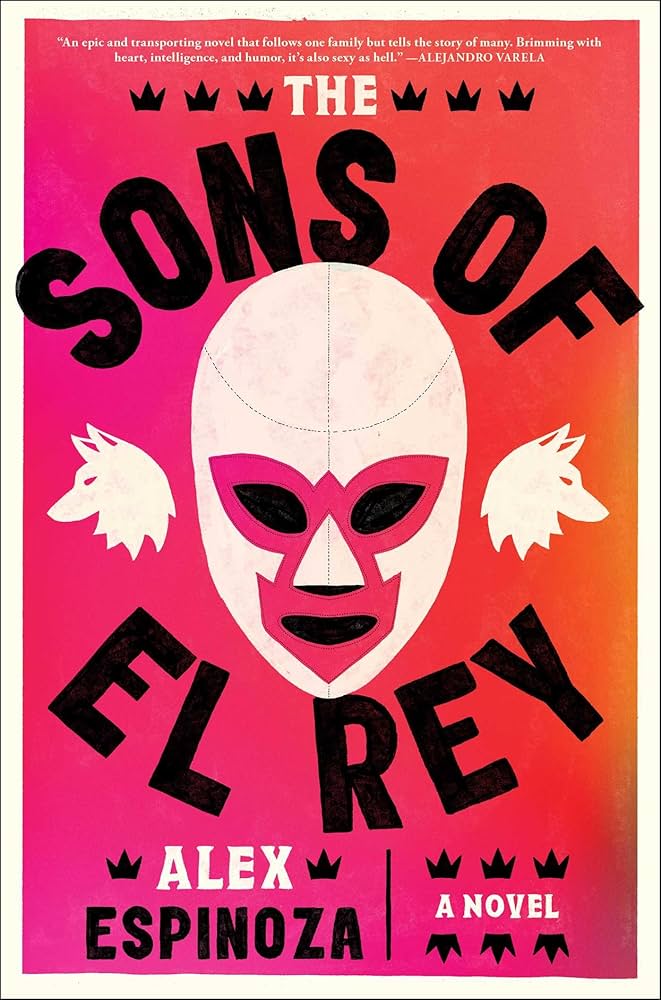
The Sons of El Rey is different from the books I typically read. I appreciated the author’s originality, most prevalent in the narrative structure, the back and forth between multiple narrators, and the interweaving of an intergenerational story that spans decades. It’s an examination of so many things (lucha culture and the contrast between LGBTQ+ societal acceptance between the 70s and today, to name a couple) and it made for a lot of introspective reading and analysis on my part. It’s not an explosive plot but it is equal parts fascinating, compelling and exciting, creating a world where you care deeply about the characters, their experiences, and their struggles to just get by in various worlds.
The Sons of El Rey
By Alex Espinoza
Genre: Literary Fiction
Subgenre: LGPTQ+ Fiction
The Best Bits
Watching fictional personas come to life
Fighting ghosts
Seeing it all come together in the end
A Few of My Favorite Things
Luchador Culture
I admittedly know nothing about luchador culture. I was vaguely aware of its existence but wrestling in general isn’t something I’ve ever understood – the personas, the acted out routines, the enormous followings. After reading this book, I better understand how lucha operates within the cultural conversation. Espinoza presents a story from the humble beginnings of a luchador on his path to international fame. We see him create his persona and, in doing so, a mythology builds around him and the other fighters in his collective. It’s fascinating to follow all of these characters and the various grudges, alliances, and stories that weave through months of matches. The excitement of the arena lifts off the page and I found myself sucked into the stories. It surprised me, and that’s the hallmark of a great book, one that takes you out of your everyday life and gives you a glimpse of something else for a little while.
A Dichotomy of the Gay Experience
The primary story alongside lucha culture lies in the queer identity of the grandfather and his grandson.
We see a ‘then’ perspective set in 1970s Mexico where homosexuality was frowned upon and it wasn’t possible to live openly. Society created macho men who always married women, always worked back breaking jobs, and never admitted how they felt or what they wanted in life. The grandfather never gets to be truly in love and it ruins three lives in the process.
The ‘now’ perspective shows the grandson who has been able to live authentically in high school, college, and adult life. While he hasn’t faced the prejudice his grandfather faced, his experience is still rough going as he’s never learned how to be intimate and open himself up to love. He prefers to focus entirely on sex, rotating through many partners and eventually working as an escort.
Both the grandfather and the grandson aren’t able to be their authentic selves, hiding behind masks (both literally and figuratively), and seeing those stories side by side shows how far we’ve come and how far we still have to go.
The Twisting Narrative
Espinoza’s narrative structure could almost be called experimental and it really worked for me. You follow five narrators, some alive, some dead, some fictional, and all of them adding various pieces to the story. So much of the story comes from characters who can’t speak in the present day, so you feel like you’re being let in on these family secrets that the family will never know. We see:
- a dying man who created a big life for himself that was absent of the love he so desired.
- a father who tried to live like his own father, following him in wrestling, business ownership, and personality.
- a grandson who uses sex to cope with the craziness of the world, who pushes love away and doesn’t know what he wants to do with his life.
- a woman who spent her whole life trying to get the credit she deserved in spite of the ignorant men surrounding her.
- a fictional character, El Rey Coyote, filling the hospital room with his musings and intense personality.
They’re all so different and yet the same in many ways. The author spent just the right amount of time with each character before moving onto the next.
Becoming Yourself (By Being Someone Else)
Espinoza examines the difficulties of living authentically as yourself from three perspectives.
The grandfather is a gay man who refuses to acknowledge his sexuality, whose life never has real, lasting love because of the choices he makes. After he moves to Mexico City, he doesn’t have the life he imagined so he creates a larger than life persona in El Rey Coyote. As Coyote, he wears the costume, becomes a hero, and is beloved by thousands, whereas in his regular life he’s too afraid to be bold and be with the man he loves.
The father is aimless in his youth, getting into drugs and constant fights, on a path to nowhere until his father throws him in the ring and creates a new persona for him in El Rey Coyote, Jr. He becomes the mirror image of his father, bringing them closer together. He becomes the son his father imagined he would have when he inhabits that character, and struggles with living authentically later in life outside of that persona. He denies his emotions and feelings, trying desperately to hold onto that lucha persona and the gym culture he spends his time around.
Finally, you have the son who spends his days and nights masquerading as an escort, fulfilling the fantasies of wealthy men who want him to be somebody else. He plays the parts, becoming macho or scary or submissive, depending on their desires. Underneath it all, he has no idea who he is, how to love anyone beyond sex, and what to do with his life.
It’s a fascinating conversation on the masks we hide behind. They wear their masks and are beloved, but only when they don their fake personas. Without them, they’re regular people just trying to get by and struggling to make ends meet. It’s a pretty brilliant examination of the human experience.


Leave a Reply