
I’m always fascinated when short little novellas are able to tell novel-sized stories, and Sun-Daughters, Sea-Daughters does just that. This Little Mermaid-inspired sci-fi story takes you into a well drawn world, flings you out into space for a bit, and gives you a glimpse of an entire universe, all in the name of love. It’s well written, uses the source material in a very unique way, and has me wanting to search for more of the author’s works.
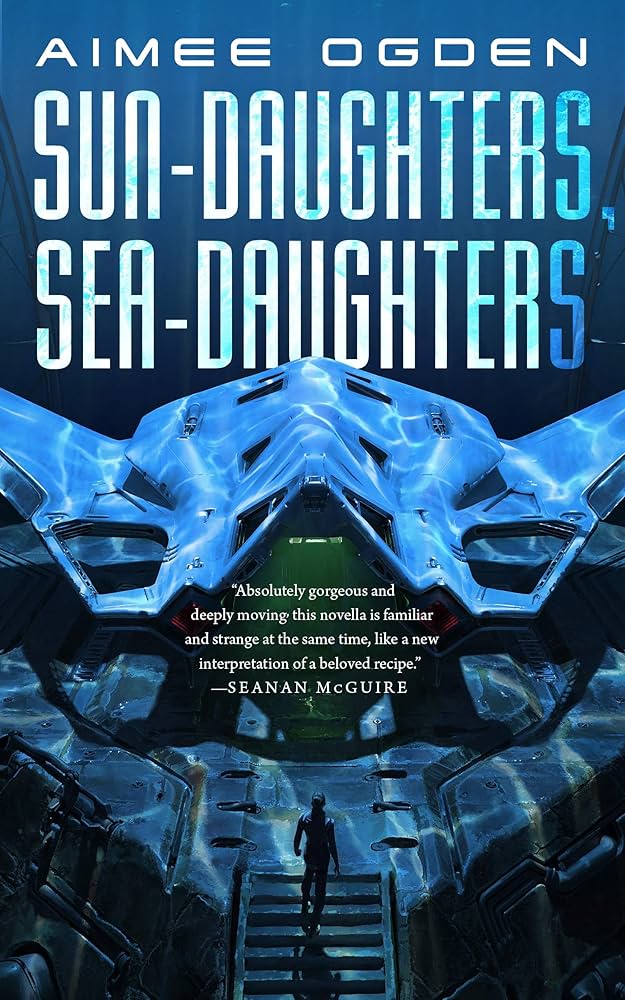
Sun-Daughters, Sea-Daughters
By Aimee Ogden
Genre: Science Fiction
Subgenre: Space Opera
This book was provided to me by NetGalley as an ARC in exchange for my honest, unbiased review.
The Best Bits
The witch’s underwater domed domicile
The enormous space station crammed with other species
The in-depth worldbuilding in such a short space
A Few of My Favorite Things
The Little Mermaid In Space
The premise is enough to get me to read anything. I love the Little Mermaid, I love space operas, and combining the two sounded impossible to me. Ogden took the basic elements – a princess who wished her way out of her undersea life because of love – and created a complex societal structure largely absent from the original story and the Disney movie. We see a witch who isn’t very witchy, instead a long lost friend/lover who wants to help, with the ulterior motive of becoming lovers again. The story goes far beyond The Little Mermaid, but that underlying theme of doing it for love plays well across the space opera subgenre. It’s a desperate trip across galaxies, involving a few crimes, many pleas, and the confusion of being thrust into worlds unknown when you’ve never thought beyond your own atmosphere. It’s such a cool premise and very well done.
Conveying Two Cultures in 100 Pages
This was the most interesting part to me, and the area that most distinguishes the story. We see a planet where sea-dwellers have a complex societal culture, both politically and socially. We see mating and birthing customs, we get a hint of political treaties that ruin the lives of heirs, and we see how those decisions could cause the kind of desperation that takes you far from your home. Alternatively, we see a land culture that doesn’t accept help from anyone, that doesn’t have a religious component, and is heavily self-reliant to the point of near-extinction. One of the societies seems medieval, the other extremely advanced, and that dichotomy provides a solid backdrop for the story.
An Ending Grounded in Reality
I completely expected the protagonist to see the space station, see how big the galaxy was, and take the chance to stay in space, reaching further and further until she’s seen it all. In reality, she agrees to stay confined to her planet for the rest of her life in order to save the man she loves. It’s a new level of growth for this Ariel-based character, showing that she has grown out of the childish ‘run away from home and see everything’ phase and is firmly in an adult phase of family, love, and wanting a home. It was a surprise twist to me, and it highlights the depth of devotion that makes up the character.
 The Genre Nerd
Leave a comment