The Red Winter is the best kind of historical fantasy, taking actual mysterious events from the past and morphing them into a mythology that’s both fascinating and terrifying. The book is a brilliant mix of French history, arcane practices, magic and witchcraft, all bundled into conversations on religion and ancient mythology. It feels like quite a feat to have written such a multi-faceted story, and I found myself transfixed from start to finish. I’ve been excited to tell anyone who would listen about this book and I’m hopeful this isn’t the last we’ll see of the Professor and his eternal companion.
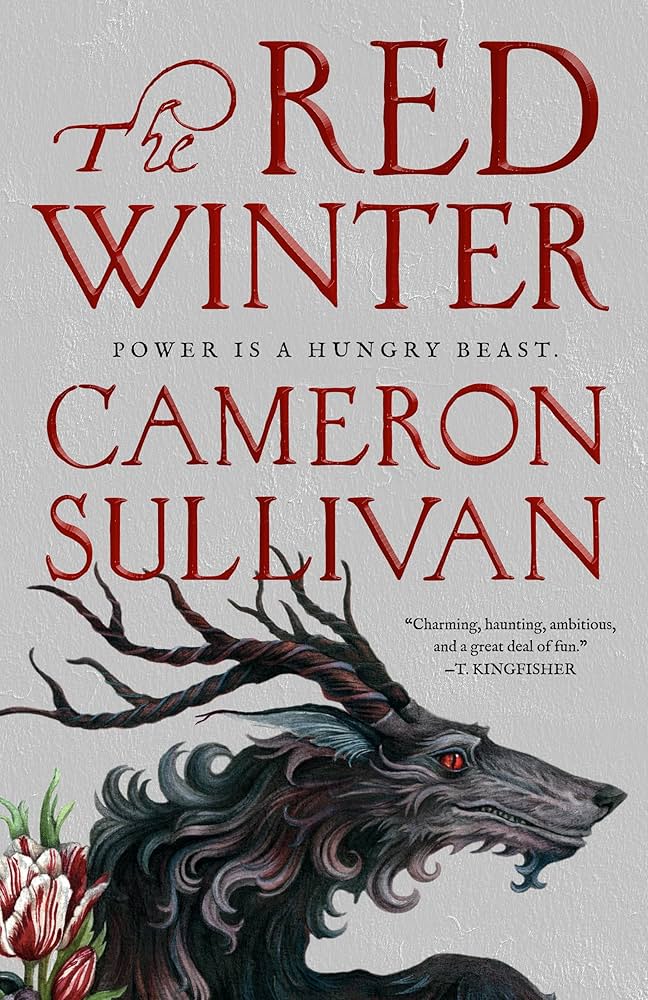
The Red Winter
By Cameron Sullivan
Published by Tor Books
Genre: Fantasy
Subgenre: Dark Fantasy, Historical Fantasy, LGBTQ+ Fantasy
This book was provided to me by NetGalley as an ARC in exchange for my honest, unbiased review.
A Few of My Favorite Things
A Morphing of Mysterious History
I was shocked to discover that the basis of the story, the Beast of Gévaudan, was a real and unexplained occurance in French history. I watched Brotherhood of the Wolf years ago (also pulled from the same historical event) and didn’t realize it was based on anything resembling fact. The book brilliantly takes pieces of history – the early days that stoked the French Revolution, Joan of Arc’s final hold on Europe, even the days of the Roman Empire – and puts them together into this historical account that’s always well-executed. It made me excited to dive deeper into the historical fantasy subgenre, one I haven’t spent a lot of time with.
The Monstrosities
The beasts in this book are truly horrifying, their forms twisted and warped, and filled with endless bloodlust. These are no self-aware creatures, only possessed things working on behalf of demons, angels and gods. Their otherworldliness takes this book out of reality, making this story a battle of immortal forces set on a mortal plane. It all feels very grand and terrifying realizing that this version of human history is really just a play going on around centuries of conflict that people aren’t actually aware of. Every miraculous thing comes from some monstrosity or bargain, casting a dark undertone over every major historical event. The book feels so original in that aspect, and I found myself always wanting to know more about the endless past of the protagonist.
So Much Magic and Arcane Wonders
There’s something magical or arcane on every page of this book, an aspect I didn’t expect when I picked it up. Sebastian leaves nothing to doubt when it comes to his immortality, his demon companion, and the magical practices he’s mastered over the centuries. They imbue all of his actions and intentions, making every situation otherworldly. We get to see magical weapons, magical words of power, arcane relics and unexplained horrors at play. It’s dark fantasy done well.
The Many Sub-Stories
I loved how far reaching the story was. We have the ongoing mystery of Sebastian and his eternal life. We have the unanswered question on the origin of his bargain with Sarmodel. We have the centuries of his past that were clearly filled with wild adventures and horrors, mentioned ever so briefly, always leaving you wanting more. We get four pieces of narrative – modern day when this is being written (mostly in the form of footnotes), the first attack of the beast in the 1760s, the second attack in the 1780s, and the time of Joan of Arc. For a while, it’s hard to connect the pieces, but when they come together it’s clear how much care the author took when crafting this story. I found them all necessary and fascinating in the end.
A Lingering Love Story
The love story wasn’t the main focus of the novel and yet somehow it lingered in every action Sebastian took. He’d had many loves in his past, hundreds I would assume, yet this one was different in ways that are never made entirely clear. He gave himself fully to this brief romance and it remained a part of him up to the present day. We see them together, their love for one another, their carefree time ironically spent in a horrifying environment filled with death and decay. It’s a love that feels both naive and unbreakable, and yet it does break, lending so much tragedy to the concluding chapters. To me, it was the final piece of the narrative that tied it all together, creating a deeply human portrait of a man who is more god than man.
 The Genre Nerd
Leave a comment